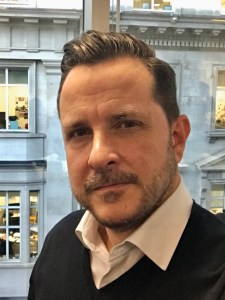
To start 2020 the Gran Orden de Caballeros de Vino welcomes the recently appointed Director at Foods & Wines from Spain for the UK, Fernando Muñoz Naranjo, and explores what is in store for Spanish wines under his new directorship.
Q: How long have you worked with ICEX?
I joined as a trainee in 1997, promoting bilateral trade relations at the Trade Commission of Spain in New Delhi, India. My fluency in Portuguese led me to postings in Brazil (1998) and Portugal (2000) before moving to the Asia-Pacific region in 2002. A 6-year term in Hong Kong was followed by a 4.5-year post at the Trade Commission of Spain in Sydney, Australia. In 2013 I returned to Hong Kong, resuming my position at the Trade Commission until 2019, when I took up the post of Director – Foods and Wines from Spain to the UK.
Q: Do you have any particular memories of your time in these different countries?
Brazil is where I spent most of my childhood, so most of my memories come from the happy days of growing up with family and friends.
India was my first posting overseas, and I remember organising early into my career the largest Spanish show ever to be held overseas, Expotecnia 1997, with the presence of HRH The Crown Prince of Spain (who is now King Felipe VI).
In Australia, we had a great meeting with the then Prime Minister, Kevin Rudd, to discuss market access conditions for Spanish infrastructure companies into the very protectionist Australian market. Also, I organised a business forum attended by HRH the King of Spain, Juan Carlos I, where I prepared his speech.
Hong Kong was my longest posting, which is why I still call it “Home Kong”. Some of the highlights and my fondest memories include being a member of the organising committee of the Spanish delegation to the Sixth WTO Ministerial Conference, in 2005. Also, being part of the EU taskforce to assist the Hong Kong Government in abolishing import taxes on wines and spirits, which led Hong Kong to be the hub of the wine trade in Asia

With Debra Meiburg MW and Benjamin Chau, Deputy Executive Director of the Hong Kong Trade Development Council (HKTDC) at the HK International Wine & Spirits Fair 2018 press conference 
With Margaret Fong, Executive Director of the Hong Kong Trade Development Council (HKTDC) and Bodegas Cuatro Rayas at the HK International Wine & Spirits Fair 2018. 
With my Hong Kong team at Asia Fruitlogistica 2019.
Q: What are your main objectives for the coming year in London?
We want to improve the relative positioning of Spanish wines towards a higher consumer segment. This means creating more synergies between our food and wine products, cuisine and culture, and ensuring that Spain’s diverse gastronomy retains a central role across our activities.
For 2020, we will be partnering with a series of Spanish restaurants in the UK as a key promotional focus for our wines. On top of engaging restaurants, this campaign will also include workshops with trade professionals and independent wine merchants – not only in London, but across the whole country.
Fernando Muñoz naranjo, director, foods & wines from Spain UK
We’re also attuned to the shifts in consumer behaviours, and the latest updates in distribution channels and production techniques – which have changed significantly in the last decade. Younger consumers have become more knowledgeable about sustainable methods of production and being a zero-waste society, and have thus shifted their habits towards natural foods and the traceability of products and ingredients.
In this regard, we plan to organise initiatives aimed at promoting innovation both in the methods of production and in the contents of products – it’s worth noting that, when it comes to organic products, Spain is currently the top EU producer in terms of cultivated land, so this is a market niche we’d like to focus on.
Last but not least, we wish to highlight the excellence of our wines, of course, and I hope to work very closely with the Caballeros and collaborate with the Order in all activities that we organise!
Q: From your short time in London, do you have any comments on wine shops, wine lists, sommeliers, the wine world generally
Coming from Spain and Australia, where local wines have pride of place in wine shops and restaurants, or even HK, where France dominates the market, I was surprised by the great variety of wines present in the UK – not only when it comes to provenance, but also different grape varieties and styles. I find the UK is a very sophisticated market, which makes my role a very interesting challenge.
Q: Can you remember your first wine?
I may not recall my first wine, but I do clearly remember arriving in Spain when I was very young and being surprised by how big a part wine had to play in popular culture. Wine was something served with every meal and not simply a luxury that some indulged in.
Q: Do you enjoy travelling?
After food and wine, travel is probably my biggest passion. During my upbringing and various postings around the world, I’ve fortunately been able to head on an adventure or fifty. I’ve notched quite a few countries under my belt, and am always looking for the next great place to discover. Happy to hear recommendations for where to go in the UK, too!
QUICK FACTS
What is your hometown in Spain?
Madrid
Your education?
I have a degree in Economics from the Complutense University of Madrid, and a Master in International Management from EOI Spain.
What languages do you speak?
Spanish, English, and Portuguese.
Your favourite food(s)?
Other than Spanish, I love Asian food in general, particularly Vietnamese for its freshness, and Sichuanese for its spiciness!
Gintonica or tinto y casera?
Gintonica!
Manzanilla or Palo Cortado?
Palo Cortado, for its uniqueness, although I love Manzanilla as well.
What do you enjoy doing/visiting over a weekend in London?
I love to wander around the backstreets and courtyards, and to get lost in the many markets and pubs!
For more information visit: www.foodswinesfromspain.com


